Bacterial Leaf Scorch Treatment in Dallas-Fort Worth, Texas
Bacterial Leaf Scorch is a systemic vascular disease caused by the bacterium Xylella fastidiosa.
What Is Bacterial Leaf Scorch?
Bacterial Leaf Scorch is a systemic vascular disease caused by the bacterium Xylella fastidiosa.
Unlike many fungal leaf diseases that remain on the surface of foliage, this pathogen colonizes the xylem tissue responsible for transporting water throughout the tree.
As bacterial populations increase, portions of the vascular system become restricted. Water movement becomes less efficient, and foliage begins to exhibit symptoms associated with moisture stress even when adequate soil moisture is present.
The disease typically progresses slowly over multiple years. Many trees survive for extended periods while experiencing gradual decline, making early diagnosis especially important.
Affected trees often continue producing new foliage each spring, creating the appearance of recovery. However, symptoms commonly return during periods of heat and environmental stress because the underlying vascular problem remains active.
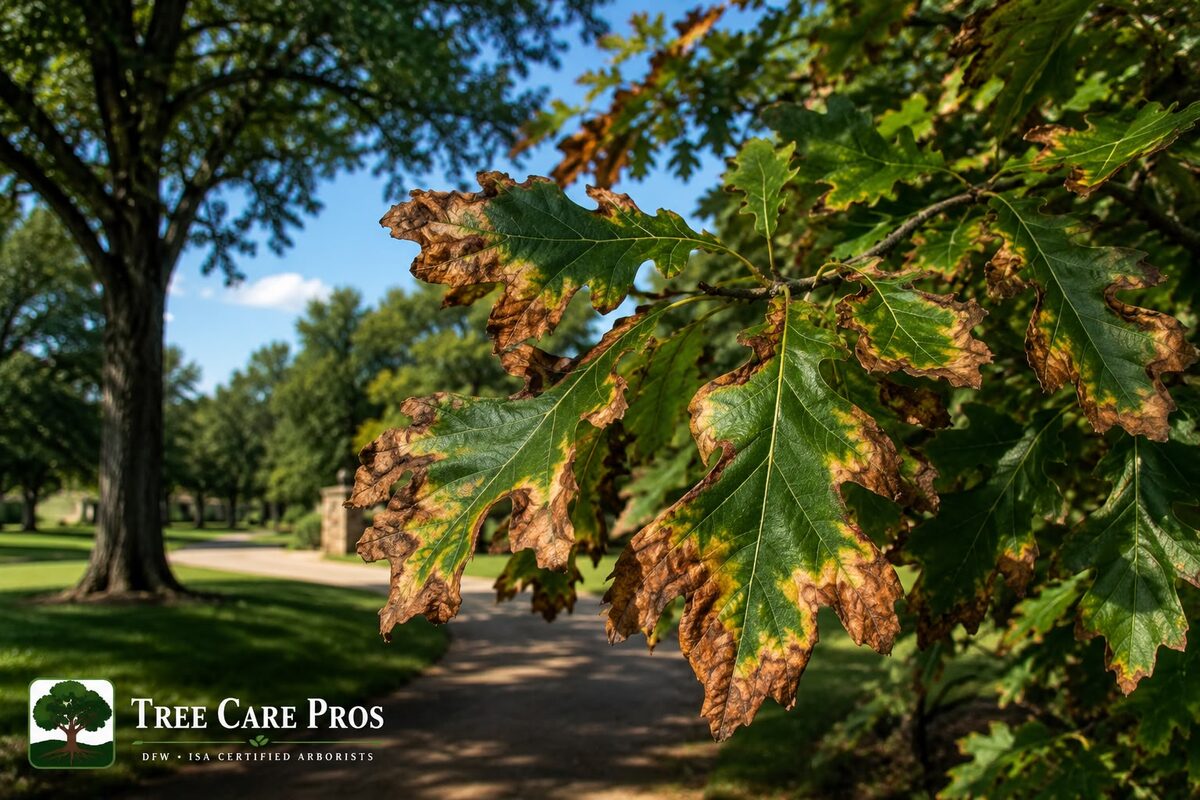
Common symptoms include:
- Marginal leaf scorch
- Brown leaf edges
- Yellow halos around necrotic tissue
- Premature leaf drop
- Sparse canopy development
- Progressive branch dieback
- Reduced annual growth
- Chronic decline
- Thinning foliage
The disease often becomes more apparent during summer when water demand is highest.
Why Bacterial Leaf Scorch Is Common in North Texas
North Texas presents several environmental factors that contribute to stress-related decline in trees affected by Bacterial Leaf Scorch.
Extended summer heat, drought cycles, compacted urban soils, construction impacts, restricted root zones, and fluctuating moisture levels place tremendous stress on shade trees throughout Dallas-Fort Worth.
Trees already challenged by vascular disease frequently struggle to meet water demands during periods of elevated temperatures. As a result, symptoms become increasingly visible throughout the growing season.
Species commonly affected in the DFW Metroplex include:
- Southern Live Oak
- Shumard Red Oak
- Pin Oak
- Elm
- Sycamore
- Mulberry
- Sweetgum
Many urban landscapes throughout Fort Worth, Burleson, Mansfield, Arlington, Weatherford, Southlake, and surrounding communities contain environmental conditions that further contribute to decline.
The most common contributing factors include:
High summer temperatures
- Drought stress
- Soil compaction
- Restricted root systems
- Poor soil biology
- Construction damage
- Root flare burial
- Excessive competition from turfgrass
- Poor drainage
- Chronic environmental stress
These conditions often accelerate symptom development and reduce the tree’s ability to tolerate infection.
Diagnosis by an ISA Certified Arborist
Proper diagnosis is critical because Bacterial Leaf Scorch is frequently confused with other disorders.
Many homeowners assume leaf scorch symptoms indicate insufficient irrigation. While drought can produce similar symptoms, Bacterial Leaf Scorch involves an internal vascular problem that cannot be corrected simply by increasing water.
An ISA Certified Arborist evaluates both the symptoms and the overall health of the tree before making recommendations.
During a professional evaluation, Tree Care Pros commonly assesses:
- Tree species
- Leaf symptom patterns
- Branch distribution of symptoms
- Root flare condition
- Soil compaction
- Drainage conditions
- Irrigation practices
- Environmental stress factors
- Insect activity
- Overall canopy density
Laboratory testing may be recommended to confirm the presence of Xylella fastidiosa when symptoms strongly suggest Bacterial Leaf Scorch.
Accurate diagnosis helps eliminate unnecessary treatments and allows management efforts to focus on preserving tree health.
Disease Progression and Long-Term Effects
Bacterial Leaf Scorch is generally considered a chronic disease rather than a rapidly lethal disease.
Symptoms often begin on isolated branches before gradually expanding throughout larger portions of the canopy. Over time, more vascular tissue becomes colonized, reducing the tree’s ability to transport water efficiently.
As photosynthetic capacity declines, carbohydrate production decreases. Reduced energy reserves affect root growth, defense mechanisms, and stress tolerance.
Typical progression includes:
- Initial leaf scorch symptoms
- Reduced water transport
- Canopy thinning
- Lower carbohydrate production
- Progressive branch dieback
- Reduced annual growth
- Increased environmental stress
- Secondary pest pressure
- Long-term decline
Without proper management, affected trees often experience gradual deterioration over many years.
Texas A&M Recommended Management Strategies
Current management recommendations focus on improving tree health and reducing environmental stress.
Because Bacterial Leaf Scorch affects the vascular system, there is currently no universally accepted cure that completely eliminates the pathogen from infected trees. However, many trees can continue functioning successfully when supported through comprehensive Plant Healthcare programs.
Management strategies frequently emphasize:
- Root health improvement
- Soil management
- Nutrient support
- Stress reduction
- Proper irrigation
- Root zone enhancement
- Canopy preservation
The goal is to maximize tree vigor while slowing decline and improving overall quality of life for the tree.
Tree Care Pros Plant Healthcare Treatment Protocol
Successful management requires a long-term strategy focused on supporting tree health from the roots upward.
Treatment programs are customized according to species, symptom severity, site conditions, and overall tree condition.
Deep Root Fertilization
Deep root fertilization helps support root development and nutrient uptake while improving overall tree vigor.
Applications may include balanced nutrient formulations designed to improve foliage density, root growth, and stress tolerance.
Trees experiencing chronic vascular stress often benefit from improved nutrient availability within the root zone.
Micronutrient Applications
Micronutrient deficiencies can further reduce the performance of already stressed trees.
Programs may include:
- Iron
- Manganese
- Zinc
- Magnesium
- Trace elements
These nutrients support chlorophyll production, metabolic activity, and overall tree function.
Soil Aeration
Compacted soils frequently limit oxygen movement and root performance.
Aeration programs may improve:
- Root respiration
- Oxygen exchange
- Water infiltration
- Root development
- Nutrient uptake
Improved root performance often helps trees better tolerate disease pressure.
Root Flare Excavation
Buried root flares are common throughout urban landscapes.
Root flare excavation improves gas exchange and helps eliminate chronic stress associated with root collar disorders.
Benefits may include:
- Improved oxygen movement
- Better root function
- Reduced stress
- Enhanced stability
- Improved nutrient uptake
Biological Soil Enhancement
Healthy soil biology supports healthy trees.
Beneficial microorganisms contribute to:
- Nutrient cycling
- Root development
- Water retention
- Stress tolerance
- Soil structure improvement
Supporting the rhizosphere is often an important component of long-term disease management.
Integrated Pest Management (IPM)
Trees affected by Bacterial Leaf Scorch frequently become susceptible to secondary insect activity.
Common pests associated with stressed trees include:
- Borers
- Scale insects
- Aphids
- Spider mites
IPM programs help reduce additional stress while supporting overall recovery efforts.
Tree Injection and Micro-Injection Therapy
Micro-injection technology may be utilized as part of a comprehensive management strategy for high-value trees.
Systemic injections provide targeted delivery of materials directly into the vascular system where transport occurs.
When combined with proper root zone management, nutrient support, and stress reduction, injections may help improve long-term preservation efforts.
Why Soil Health Matters
Healthy trees begin below ground.
Root systems require oxygen, nutrients, water, and healthy biological activity to function properly. When soil conditions become unfavorable, disease symptoms often become more severe.
Healthy soils support:
- Root respiration
- Oxygen exchange
- Nutrient cycling
- Water movement
- Microbial activity
- Root development
Healthy soils help promote:
- Improved root growth
- Better nutrient uptake
- Increased stress tolerance
- Improved canopy density
- Greater drought resistance
- Enhanced long-term vigor
Managing soil conditions is often one of the most important components of preserving trees affected by Bacterial Leaf Scorch.