Tree Disease Treatment

Fire Blight Treatment in Dallas-Fort Worth, Texas

Fire Blight is a bacterial disease caused by Erwinia amylovora. The bacterium attacks actively growing tissues and is especially aggressive during periods of warm temperatures combined with elevated humidity.

Overview

What Is Fire Blight?

Fire Blight is a bacterial disease caused by Erwinia amylovora. The bacterium attacks actively growing tissues and is especially aggressive during periods of warm temperatures combined with elevated humidity.

The pathogen commonly enters through blossoms, young shoots, pruning wounds, storm injuries, and natural openings within plant tissues. Once inside the plant, the bacterium multiplies and spreads through vascular tissues, causing localized dieback and progressive decline.

The disease is particularly damaging because it affects actively growing tissues that are critical to canopy development and energy production.

Common host species include:

  • Bradford Pear
  • Callery Pear
  • Ornamental Pear
  • Crabapple
  • Apple
  • Hawthorn
  • Pyracantha
  • Photinia
  • Quince

Common symptoms include:

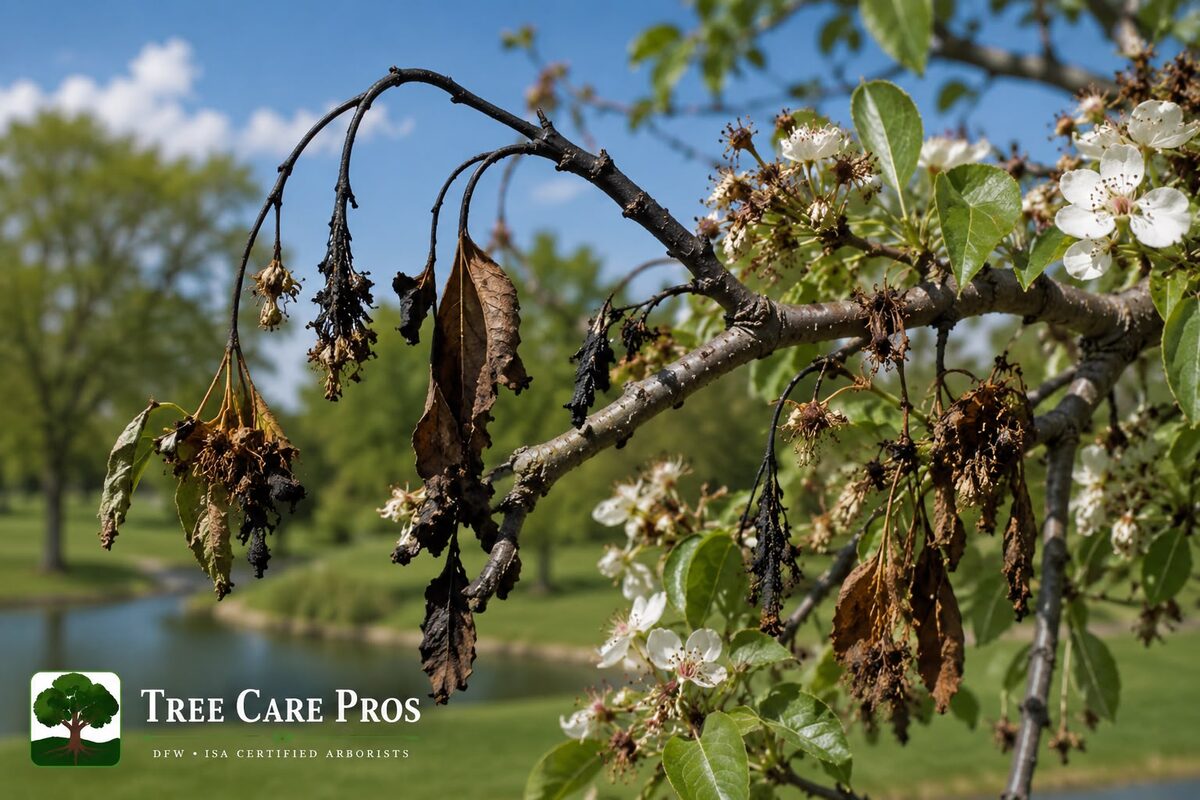
  • Blackened shoots
  • Burned appearance
  • Shepherd’s crook growth
  • Blossom blight
  • Branch dieback
  • Darkened bark
  • Cankers
  • Premature leaf death
  • Progressive decline

In severe cases, entire scaffold branches may become infected and die.

North Texas

Why Fire Blight Is Common in North Texas

Fire Blight outbreaks often occur when weather conditions favor bacterial growth and spread.

Throughout Dallas-Fort Worth, spring weather patterns frequently create ideal conditions for disease development. Warm temperatures combined with rainfall, humidity, and active plant growth allow bacterial populations to increase rapidly.

Many ornamental pear trees planted throughout North Texas landscapes are highly susceptible to infection. As a result, Fire Blight remains one of the most commonly diagnosed bacterial diseases in ornamental landscapes.

Environmental stress often increases susceptibility.

The most common contributing factors include:

  • Warm spring temperatures
  • High humidity
  • Rainfall during bloom
  • Excessive nitrogen fertilization
  • Dense canopy growth
  • Poor airflow
  • Drought stress
  • Soil compaction
  • Root dysfunction
  • Environmental stress

Trees under chronic stress frequently experience more severe infections.

Diagnosis

Diagnosis by an ISA Certified Arborist

Accurate diagnosis is critical because several conditions can resemble Fire Blight.

Symptoms may be confused with:

  • Freeze damage
  • Drought stress
  • Twig blight
  • Herbicide injury
  • Environmental scorch
  • Insect damage

An ISA Certified Arborist evaluates symptom development, species susceptibility, site conditions, and disease progression before making treatment recommendations.

During a professional evaluation, Tree Care Pros commonly assesses:

  • Host species
  • Shoot dieback patterns
  • Canker development
  • Root flare condition
  • Soil compaction
  • Drainage conditions
  • Fertility programs
  • Environmental stress factors
  • Tree vigor
  • Canopy density

Proper diagnosis helps eliminate unnecessary treatments and improves management success.

Progression

Disease Progression and Long-Term Effects

Fire Blight frequently begins in blossoms or newly emerging shoots.

As bacterial populations increase, the infection spreads through vascular tissues and begins affecting larger portions of the canopy.

Early symptoms often include blackened shoots and blossom dieback. As the disease progresses, branches may develop cankers that serve as reservoirs for future infections.

Typical progression includes:

  • Blossom infection
  • Shoot infection
  • Shepherd’s crook development
  • Branch dieback
  • Canker formation
  • Reduced canopy density
  • Lower photosynthetic capacity
  • Progressive decline
  • Structural loss

Repeated infections can significantly reduce vigor and ornamental value.

Management

Texas A&M Recommended Management Strategies

Texas A&M recommendations emphasize sanitation, proper pruning, stress reduction, and proactive management.

Management strategies often focus on:

  • Early detection
  • Removal of infected tissue
  • Proper pruning practices
  • Improved airflow
  • Stress reduction
  • Balanced nutrition
  • Long-term monitoring

Reducing environmental stress frequently improves the tree’s ability to tolerate future infections.

Proper pruning timing is critical to reducing disease spread.

Treatment

Tree Care Pros Plant Healthcare Treatment Protocol

Successful Fire Blight management requires addressing both the disease and the environmental conditions contributing to susceptibility.

Deep Root Fertilization

Deep root fertilization supports root development, nutrient uptake, and canopy recovery.

Healthy root systems improve overall vigor and help support healthy growth following pruning and disease suppression efforts.

Micronutrient Applications

Balanced nutrition supports healthy growth and physiological function.

Programs may include:

  • Iron
  • Zinc
  • Manganese
  • Magnesium
  • Trace elements

Micronutrients help support chlorophyll production and stress tolerance.

Soil Aeration

Compacted soils contribute to chronic stress and poor root performance.

Soil aeration improves:

  • Root respiration
  • Oxygen movement
  • Water infiltration
  • Nutrient uptake
  • Root development

Reducing root stress often improves disease tolerance.

Root Flare Excavation

Buried root flares frequently contribute to decline and reduced vigor.

Root flare excavation may improve:

  • Gas exchange
  • Root health
  • Nutrient uptake
  • Long-term stability

Healthier root systems often support healthier canopies.

Biological Soil Enhancement

Healthy soils support beneficial microorganisms that assist with nutrient cycling and root development.

Benefits may include:

  • Improved soil structure
  • Better nutrient availability
  • Enhanced root growth
  • Increased stress tolerance

Supporting the rhizosphere remains an important component of Plant Healthcare.

Integrated Pest Management (IPM)

Trees weakened by Fire Blight may become more vulnerable to secondary insect pressure.

IPM programs may help manage:

  • Aphids
  • Scale insects
  • Borers
  • Leaf-feeding insects

Reducing additional stress supports long-term recovery.

Sanitation Pruning Programs

One of the most important management tools for Fire Blight is proper sanitation pruning.

Removing infected tissues helps reduce bacterial reservoirs and limits future spread.

All pruning should follow ANSI A300 standards and accepted arboricultural practices.

North Texas

Why Soil Health Matters

Healthy trees begin below ground.

A tree’s ability to tolerate disease pressure depends heavily upon root health, nutrient availability, and overall vigor.

Healthy soils support:

  • Root respiration
  • Oxygen exchange
  • Nutrient cycling
  • Water movement
  • Beneficial microorganisms
  • Root development

Healthy soils help promote:

  • Strong root systems
  • Improved nutrient uptake
  • Better stress tolerance
  • Enhanced canopy density
  • Greater disease resistance
  • Long-term health

Improving soil conditions often contributes significantly to long-term disease management.

How to recognize it

Identifying Fire Blight

Sudden 'scorched' appearance on blossoms, shoots, and young branches — they wilt, brown, and curl into a 'shepherd's crook' shape. Bacterial ooze may be visible.

Affected trees

Which species get fire blight

The trees most commonly affected in DFW:

Ornamental pears (Bradford, Cleveland)ApplesCrabapplesQuinceHawthornLoquatPyracantha
DFW prevalence

How common is this in North Texas?

Common on ornamental pears after wet springs.

Treatment

How we treat fire blight

Prompt sanitation pruning — cut blighted branches 8–12 inches below visible damage, disinfect tools between cuts. Streptomycin sprays during bloom for prevention on high-value trees. Avoid spring fertilization (encourages susceptible new growth).

Prevention

How to prevent fire blight

Plant resistant cultivars. Don't overfeed. Disinfect pruning tools.

What to expect

Treatment timeline

Aggressive in spring/early summer; quiets in heat of summer.

Fire Blight FAQs

Will my Bradford pear survive fire blight?

Often yes if you sanitation-prune promptly. Repeated outbreaks weaken the tree over years.

Can it spread to my oaks?

No — fire blight is limited to the rose family (Rosaceae).

Think your tree has Fire Blight?

Get a free expert diagnosis — usually within 48 hours.

Free VisitCall (817) 670-4404
Deep diagnosis — ISA Certified Arborist

Fire Blight in DFW trees: full diagnostic and treatment depth

How Fire Blight actually behaves in North Texas

Fire Blight is one of the named tree-health problems we diagnose regularly on DFW properties. Like most tree diseases, it presents differently in our specific climate and soil context than it might in cooler or more acidic regions. Our ISA Certified Arborists have decades of combined experience tracking how Fire Blight progresses on Dallas-Fort Worth trees specifically — and that experience is what separates accurate diagnosis from the symptom-matching guesswork that often leads to ineffective treatment.

Differential diagnosis — what Fire Blight is NOT

One of the most common mistakes in tree health is misdiagnosis. Several DFW tree problems present with similar visible symptoms — leaf yellowing, marginal browning, canopy thinning, branch dieback — but have different underlying causes and different treatments. Our diagnostic visit doesn't just identify the most likely problem; we systematically rule out the alternatives. For example, iron chlorosis and bacterial leaf scorch can both produce yellowed leaves but need entirely different protocols. Oak wilt and BLS share early symptoms but require completely different actions. Drought stress and root rot can both cause uniform canopy decline. Lab work (Texas Plant Disease Diagnostic Lab at Texas A&M) provides definitive confirmation when visual diagnosis is ambiguous.

The treatment protocol we follow

Once we have a confirmed diagnosis, we follow established arboricultural treatment protocols documented in ISA references and supported by peer-reviewed research. Treatment is always documented in writing with specific product, dose, application method, frequency, and expected outcome. We use TDA-licensed pesticide applicators for any chemical work, follow ANSI A300 standards for any associated pruning, and provide before/after photos for client records.

Prevention going forward

The best treatment is prevention — once Fire Blight has been diagnosed, we develop a prevention strategy for your other trees. This typically includes cultural practices (proper watering, mulching, avoiding wounds during high-risk windows), monitoring schedules (annual or semi-annual visits to catch new infections early), and where appropriate, prophylactic treatments on high-value at-risk trees. Plant Health Care (PHC) programs are the structured way to implement long-term prevention across an entire property.

When to schedule treatment vs monitor

Not every tree with Fire Blight needs immediate aggressive treatment. We make individualized recommendations based on tree value, current disease progression, surrounding trees' risk, and your overall landscape goals. About 30% of our DFW diagnostic visits end with "monitor and observe" rather than "treat now." Honesty about that distinction is what earns our 4.9-star reputation across 127+ Google and BBB reviews.

Pricing transparency

Treatment costs in DFW depend on tree size, severity, and intervention type. Most disease-treatment programs at Tree Care Pros run $200-$1,200 per tree per treatment, with multi-tree and annual program discounts available. Every estimate is free and written before any work begins. Call (817) 670-4404 to schedule.
Call (817) 670-4404