
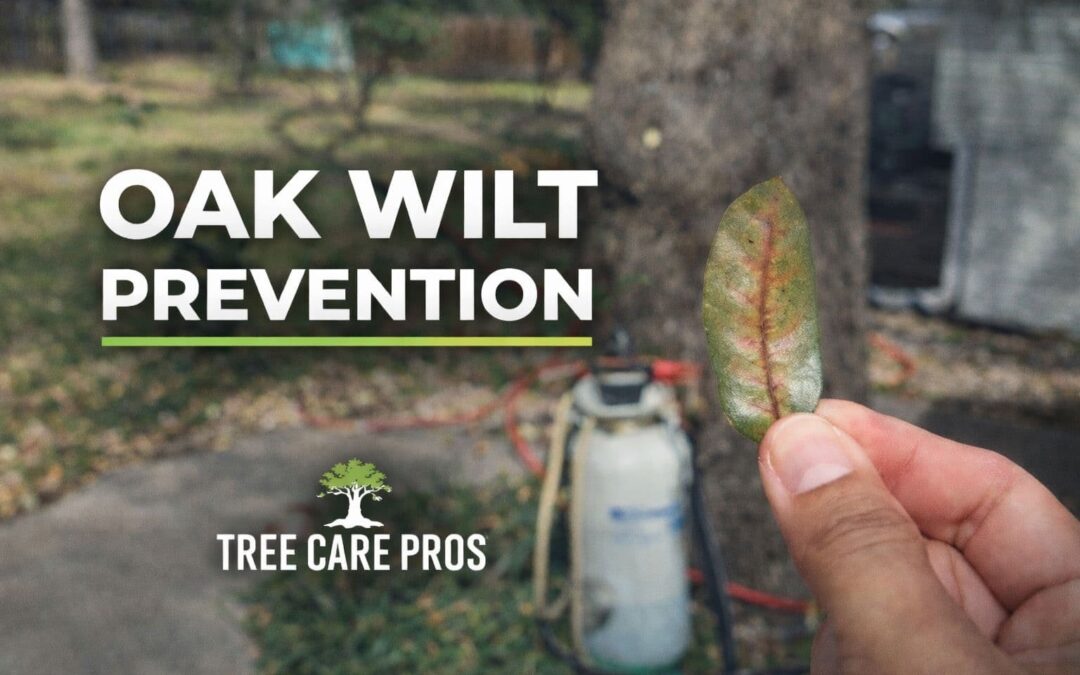
Mature Live Oaks are one of the most valuable and iconic shade trees in Fort Worth landscapes. The species, Live Oak (Quercus virginiana), is highly susceptible to Oak Wilt — a lethal vascular fungal disease that continues to impact properties across Tarrant County.
If you own Live Oaks in Fort Worth, proactive prevention is not optional — it is essential risk management.
What Is Oak Wilt and How Does It Kill Live Oaks?
Oak Wilt is caused by the fungal pathogen Bretziella fagacearum. This organism attacks the tree’s vascular system (xylem), which transports water from the roots to the canopy.
How Oak Wilt Spreads in Fort Worth
Oak Wilt moves in two primary ways:
1. Root Graft Transmission (Most Common in Live Oaks)
Live Oaks naturally form interconnected root systems. If one tree becomes infected, the fungus can move underground to neighboring trees through these root grafts. This is why we often see expanding “disease centers” where multiple trees decline in a circular pattern.
2. Beetle Transmission (Common in Red Oaks)
Sap-feeding nitidulid beetles are attracted to fungal spore mats that form under the bark of infected Red Oaks. These beetles can carry spores to fresh wounds on healthy trees.
Once inside a Live Oak, the fungus colonizes the xylem. The tree responds by producing tyloses and gums in an attempt to block the infection. Unfortunately, this defense also blocks water transport, leading to:
- Leaf margin bronzing
- Rapid leaf drop
- Canopy thinning
- Eventual tree mortality if untreated
Why Oak Wilt Pressure Is High in Fort Worth, TX
Fort Worth and surrounding areas are considered high-incidence zones for Oak Wilt according to the Texas A&M Forest Service.
Contributing risk factors include:
- Dense Live Oak populations
- Shared root systems
- Storm damage and pruning wounds
- Construction-related root stress
- Periodic drought conditions
In urban environments, high-value specimen trees are especially vulnerable.
State Recommendation — Treatment Every Two Years
The Texas A&M Forest Service recommends preventative fungicide injections every two (2) years for healthy, high-value Live Oaks in high-risk areas like Fort Worth.
This interval maintains effective fungicide levels within the vascular system and significantly reduces the likelihood of infection.
Preventative treatment is far more cost-effective than managing an active outbreak or losing multiple trees connected through root systems.
Our Preventative Treatment Process (Macro-Infusion)
Tree Care Pros utilizes a macro-infusion system to deliver systemic fungicide directly into the root flare.
Why Macro-Infusion?
- Direct vascular delivery
- Uniform canopy distribution
- Minimal environmental exposure
- Long-term systemic protection
- ISA-aligned best management practice
The fungicide moves upward with transpiration, creating an internal barrier against fungal colonization.
Cause → Effect → Risk → Solution
- Cause: High regional Oak Wilt pressure and interconnected root systems
- Effect: Fungal colonization of vascular tissue
- Risk: Rapid canopy loss and multi-tree mortality
- Solution: Preventative macro-infusion every two years
When to Consult a Certified Arborist
In high-incidence areas like Fort Worth, consultation should occur before symptoms develop. If your property contains mature Live Oaks near other oaks, shared root zones, or known Oak Wilt centers, proactive evaluation is recommended. An ISA Certified Arborist can assess root connectivity, site stress, and overall tree health to determine whether preventative macro-infusion is appropriate.
Immediate evaluation is critical if you observe leaf margin bronzing, sudden spring leaf drop, canopy thinning, nearby oak mortality, or recent storm damage or pruning wounds. In Oak Wilt management, early assessment and intervention are essential to prevent multi-tree loss and contain disease spread.
Conclusion
Oak Wilt remains one of the most destructive threats to mature Live Oaks in Fort Worth. Because the disease spreads underground through interconnected root systems and progresses rapidly once inside the vascular system, waiting for visible symptoms is not a responsible management strategy.
Preventative macro-infusion on a two-year cycle is a science-based, state-supported approach that protects high-value trees before infection occurs. In high-pressure regions like Fort Worth, proactive treatment is not just tree care — it is long-term asset protection.
For general tree-care best practices, homeowners can also reference guidance from the Texas A&M Forest Service, https://tfsweb.tamu.edu/trees/, a trusted authority on Texas tree health. If you’d like to schedule a consultation, please call us at 817-670-4404 or visit https://www.treecare-pros.net
Hello community, Jon Friar here, ISA Certified Arborist with Tree Care Pros. I’m located here in Fort Worth, Texas. In this video, I am demonstrating a preventative macro-infusion treatment on a mature Live Oak (Quercus virginiana). This species is highly susceptible to Oak Wilt, a lethal vascular fungal disease affecting thousands of trees across North Texas.
